
The surprising backstage of ‘auto-generated’ blog posts
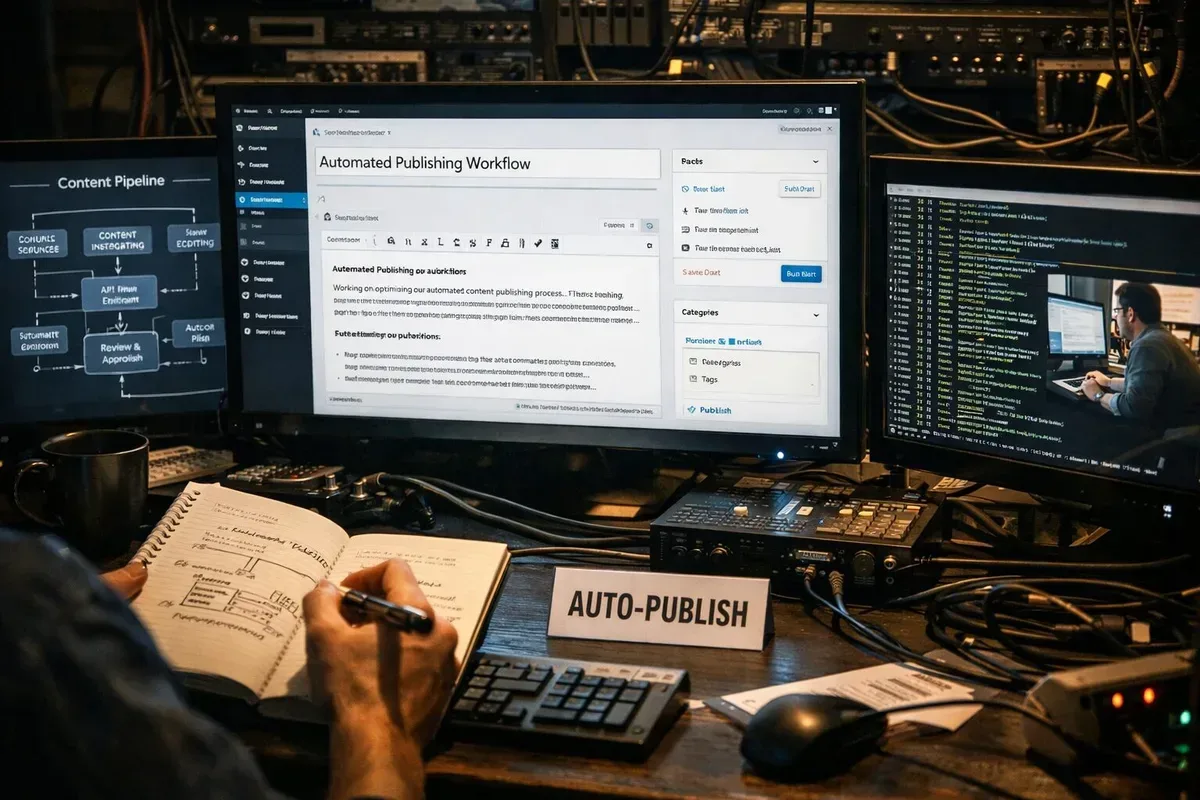
Most people picture a single AI bot typing away and publishing finished posts. The reality is more like a miniature production studio with specialised departments: ingestion, drafting, fact-checking, SEO treatment, formatting and delivery. Each step can be automated, but automation is rarely uniform. Systems orchestrate models, third-party APIs, templates and human review queues, stitching them together into what the reader sees as a single clean post.
Understanding this studio view clarifies why results vary so much between services. Some providers ship a near-raw draft directly to a WordPress endpoint; others run multiple passes — semantic improvement, headline optimisation, image suggestion — before anything reaches your site. The difference is often invisible to end users, yet it determines reliability, quality and compliance.
The hidden pipelines: how content is actually constructed
Auto-generation seldom starts with an empty prompt. It typically begins with content signals: keywords from a brief, analytics-backed topic ideas, competitor headlines, or a brand’s style guide. These signals feed an orchestration layer that builds a multi-stage pipeline.
Stage one is topic and outline generation. Stage two expands that outline into sections, often using different model prompts per section to control tone and depth. Stage three applies post-processing: removing hallucinations, enforcing brand voice, injecting internal links and adding structured data. Finally, a formatter converts the result into WordPress-ready HTML or a CMS-compatible JSON payload. This pipeline approach explains why some platforms (including specialised services like autoarticle.net) can claim both speed and consistency: they automate coordination, not just generation.
Why delivery is more than a single API call
Publishing to WordPress is not simply POST /posts with content. Real-world delivery must account for authentication tokens, user roles, featured media uploads, category taxonomies, SEO meta fields and revision histories. Many auto-publish systems implement multi-step delivery: upload images to the media library, attach IDs to the post payload, set the correct author and schedule, then trigger cache purges.
There are also error-handling layers. If the REST API times out or a plugin blocks programmatic posts, the system falls back to queuing for manual publish or retries with exponential backoff. Some providers implement webhooks so editors can intercept drafts, while others integrate directly with Gutenberg blocks or HubSpot modules for a smoother native experience.
The invisible compromises: speed, accuracy and compliance
What most customers don’t see are trade-offs baked into automation. Prioritising speed can mean fewer factual checks; prioritising accuracy may require more expensive human review. Compliance — copyright, data protection, disclosure of AI authorship — often lives outside the model and must be enforced by policy engines.
Another subtle compromise is SEO hygiene. Automated articles may be optimised for keywords, but without nuanced editorial judgement they can miss topical relevance, user intent or timely data. Good systems therefore add layers: automated schema markup, internal linking heuristics and freshness scoring. These invisible checks are what elevate a mere generated draft into a post that ranks and converts.
Human-in-the-loop: the secret ingredient
The most sustainable setups are hybrid. Humans set the strategy, review edge-case content, and handle context that models struggle with. Editors also curate images, ensure legal compliance and make judgement calls about controversial topics. Automation frees editors from repetitive grunt work — headline A/B testing, alt-text generation, metadata completion — allowing them to focus on higher-value tasks.
This human orchestration often manifests as lightweight approval UIs, annotated change logs and adjustable automation thresholds. Teams can dial the autonomy up for routine evergreen posts and down for sensitive subjects, achieving a pragmatic balance between scale and responsibility.
Practical implications for publishers and a quick note on services
If you’re evaluating auto-generation, ask not just “how fast” but “what pipeline and guardrails” a provider offers. Look for transparency about model prompts, revision workflows, data sources and how publishing failures are handled. Check whether the service produces WordPress-ready HTML, supports Gutenberg or offers HubSpot compatibility if needed.
For publishers seeking turnkey automation with orchestrated delivery, platforms such as autoarticle.net demonstrate the approach: they combine AI drafting with CMS connectors and delivery logic so posts arrive formatted and schedulable. Ultimately, the real value is process design — understanding and controlling the backstage so that automation scales without surprises.