
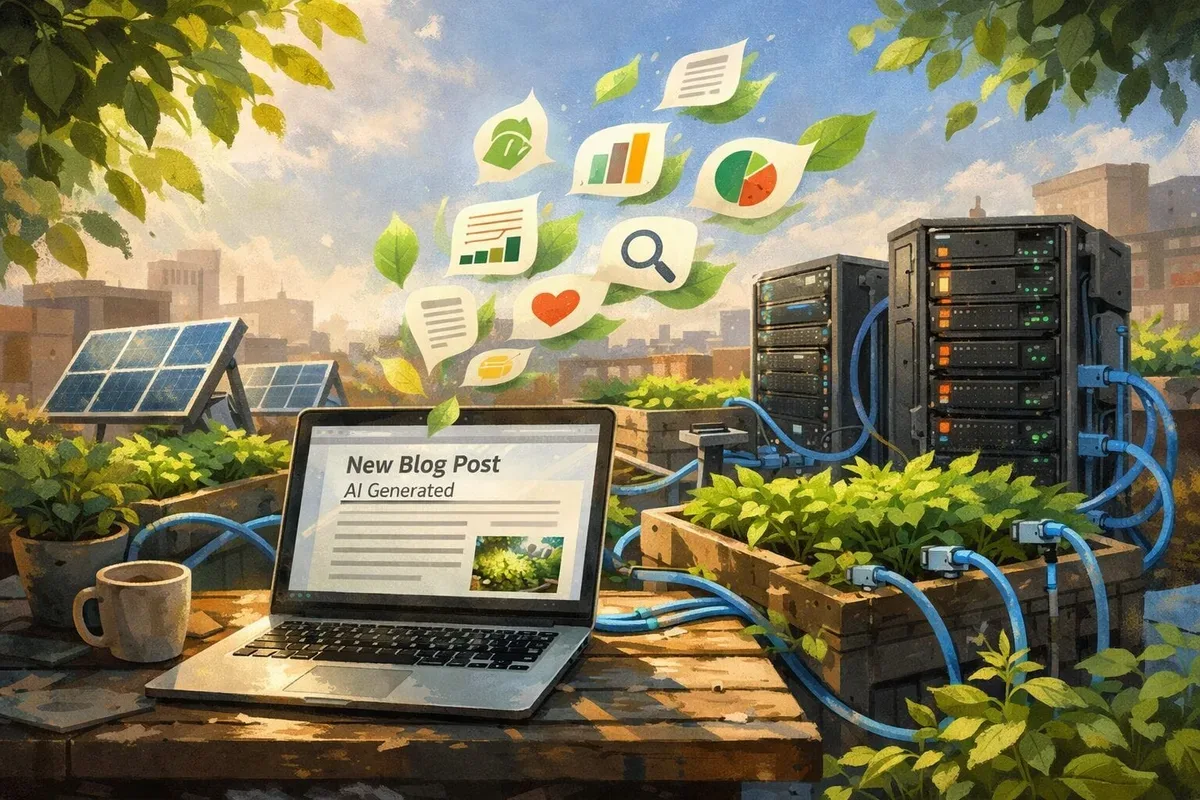
Introduction — Why Automated Blogging Matters for the Planet
When we talk about sustainability, we usually picture solar panels, recycling bins or electric cars. Few people immediately think of blog posts. Yet the production, hosting and distribution of digital content carries a measurable environmental footprint. Automated blogging tools change that equation: they can be either a hidden accelerator of carbon emissions or a powerful efficiency lever that reduces waste. This article isn’t a how-to on plugins; it’s a thoughtful look at how beginners can make automation a force for environmental good rather than just a productivity hack.
Think of automated blogging as an assembly line for ideas. Done poorly, it becomes a conveyor belt churning ephemeral posts that nobody reads. Done well, it turns occasional effort into durable, high-value content with a far lower emissions-per-read. For newcomers, the choices you make early on — from which automation platform you use to how you schedule and refresh content — determine whether your blog helps or harms sustainability goals.
The Carbon Maths of Words: Measuring the Hidden Footprint
Before you automate, it helps to understand the units. Every API call to an AI service, every saved draft on a server, every image generated and every CDN request consumes electricity. Multiply micro-operations across hundreds of posts and months, and the impact becomes real.
Look beyond the sensational headlines about ‘AI energy use’ and think in practical terms: emissions-per-article and emissions-per-engagement. A 2,000-word evergreen guide that draws consistent traffic for years will have a much lower emissions-per-read than fifty low-value posts that attract no audience. So, automation can reduce overall footprint by enabling you to produce fewer, better-quality pieces that deliver long-term value. That’s true sustainability — minimising resource use while maximising impact.
For beginners, a simple thought experiment helps: will automation make you publish more low-quality content or fewer, higher-quality assets? Aim for the latter and you’re already leaning green.
Design Choices That Cut Emissions (and Practically Save Money)
Sustainability-friendly automation is mostly about design choices. Pick efficient models and intelligent prompts to reduce needless token usage. Disable excessive iterative drafts and prefer one strong generation over five marginal tweaks. Use structured templates so AI focuses on necessary parts rather than generating entire entires from scratch every time.
Hosting matters too. Static-site generation, combined with a CDN, reduces server compute for each page view. If you use platforms like WordPress or HubSpot, choose themes and plugins that serve compressed assets and avoid heavy client-side processing. Tools such as autoarticle.net can generate content for both WordPress and HubSpot — and using them efficiently (batching requests, reusing cores of text across posts) reduces cumulative API calls and thus energy use.
Finally, schedule heavy content-generation tasks for off-peak hours where grids are greener. Some regions have higher renewable energy mixes at night; queuing non-urgent generations for those times can lower your effective carbon footprint.
Lifecycle Thinking: Make Content Live Longer, Not Just Faster
Automation tempts creators to chase novelty, but longevity is where sustainability shines. Treat posts as living assets: automate updates, canonical cross-linking and repurposing instead of constant re-creation. A single high-quality article can be refreshed with automated research summaries, updated data and fresh CTAs — far cheaper (and greener) than publishing a new piece.
Use automation to audit your archive. Periodic AI reviews can identify outdated pieces, combine overlapping posts into comprehensive guides, or flag low-performance material for consolidation. This reduces the churn of generating entirely new content and amplifies the value of what you already own. The result: less compute spent overall, better user experience, and a tidier, more sustainable content estate.
Ethics and Responsible Sourcing: Training Data, Attribution and Waste
Sustainability extends beyond kilowatt-hours. Consider the ethical sourcing of training data and the reputational risks of careless automation. Encourage transparency in your automation stack: note when content is AI-assisted, attribute sources properly, and avoid generating low-value noise that wastes readers’ time. These practices preserve trust and reduce the need for corrective content later — another indirect emission savings.
Beginners should prefer services and partners that commit to efficiency and ethical data use. Ask questions: does your provider optimise models for latency and cost? Do they publish sustainability reports? Tools like autoarticle.net can accelerate production, but pair them with responsible policies — reuse, update and cite — to prevent informational waste.
Practical Starter Checklist: Green Habits for Automated Bloggers
1) Focus on evergreen content and automate updates rather than constant new pieces.
2) Batch content generation to reduce repetitive API overhead.
3) Choose efficient hosting: static sites + CDN where possible.
4) Use concise prompts, templates and limit iterations to cut token use.
5) Schedule heavy processing during greener grid periods.
6) Audit archives periodically to merge, refresh or retire posts.
7) Prefer providers with transparency on energy use and data practices.
These steps are simple and immediately actionable for a beginner. They also shift your mindset: automation becomes a tool for quality and durability, not just speed.
Conclusion — Small Choices, Lasting Impact
Automated blogging for beginners is often sold as a fast track to volume. If you reframe it through sustainability, it becomes a pathway to smarter output: fewer, better pieces that serve readers longer and cost the planet less. The environmental benefits aren’t automatic; they’re the result of deliberate design, ethical sourcing and sensible workflows. Start small, adopt green habits, and your automated blog can do more than publish — it can steward digital resources responsibly.