
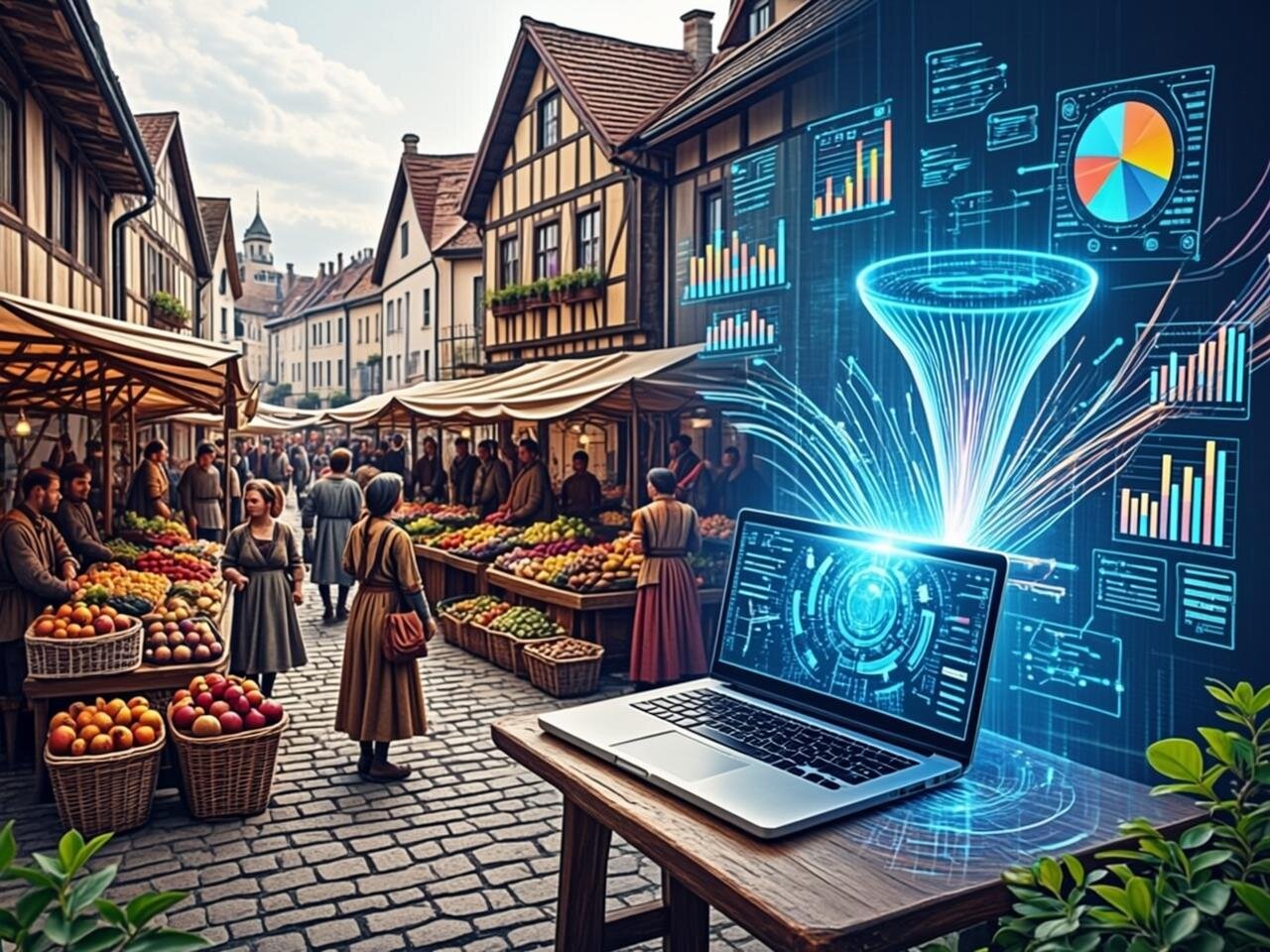
When ‘Traffic’ Meant Hooves, Not Hits
Picture this: it’s 1247 in a bustling market town in medieval England. A merchant stands behind his stall, watching people stream past—literally traffic on cobblestones. He’s not thinking about bounce rates or conversion funnels, but he’s doing exactly what we do today: trying to turn passers-by into paying customers.
The word ‘traffic’ itself has surprisingly ancient roots. Long before it referred to website visitors, it came from the Old Italian ‘traffico’—meaning trade or commerce. So when we talk about ‘website traffic’ today, we’re actually using a word that has meant ‘potential customers’ for over seven centuries. The merchants of Venice and Genoa understood something fundamental: traffic without trade is just noise.
Those medieval stallholders were the original conversion optimisers. They arranged their wares at eye level (early UX design), shouted catchy phrases (the first headlines), and offered free samples (freemium models, anyone?). The fundamental challenge was identical to ours: how do you transform movement into money?
The Town Crier Was the First SEO Strategist
Before Google’s algorithms decided what content deserved visibility, there were town criers. These bell-ringing heralds were essentially human search engines, broadcasting information that needed to reach the widest possible audience. Their success depended on the same principles that govern modern SEO: relevance, timing, and authority.
A skilled crier knew which streets had the most foot traffic at different times of day. He understood that announcing a fresh fish catch worked better near taverns at noon, whilst tax proclamations were best delivered near the guildhalls. This was primitive audience segmentation—delivering the right message to the right people at the right moment.
The parallel to modern content strategy is remarkable. When you write blog posts targeting specific keywords, you’re essentially choosing which ‘streets’ to stand on. The crier’s bell was his meta description—an attention-grabbing snippet that compelled people to stop and listen. And just like today’s content creators, criers who spread misinformation quickly lost their audience’s trust.
Shopkeepers and the Original Analytics
Victorian-era shopkeepers developed an almost instinctive form of analytics that would make modern data scientists nod in recognition. A good shopkeeper could tell you, without any software, which displays attracted the most attention, what times of day brought different types of customers, and which products served as ‘gateway purchases’ that led to bigger sales.
They kept mental—or sometimes literal—tally books tracking customer behaviour. The positioning of the till, the arrangement of window displays, even the scent of the shop were all carefully calibrated based on observed patterns. This was A/B testing in its purest form: try something, watch what happens, adjust accordingly.
The leap from these observational methods to digital analytics is smaller than you might think. When you check your website’s heat maps or review user journey flows, you’re doing exactly what those Victorian shopkeepers did—just with better tools. The questions remain unchanged: Where do people look first? Where do they hesitate? What makes them leave?
From Cobblestones to Clicks: The Digital Inheritance
The early internet pioneers didn’t invent customer acquisition—they inherited it. When the first commercial websites appeared in the mid-1990s, their creators unconsciously replicated patterns that had worked in physical commerce for millennia. Homepages became digital shop fronts. Navigation menus replaced aisle signs. ‘Contact us’ pages were the modern equivalent of a shopkeeper’s greeting.
What changed wasn’t the fundamental challenge but the scale and speed. A medieval merchant might see a few hundred potential customers a day; a website can see thousands in an hour. But this amplification made the core principles more critical, not less. When you’re dealing with volume, small improvements in conversion rates compound dramatically.
This is where modern tools become invaluable. Platforms like autoarticle.net recognise that consistent, quality content is the digital equivalent of keeping your shop open and well-stocked every day. Their automatic A.I. article generation for WordPress and HubSpot blogs helps maintain that crucial flow of fresh ‘displays’ that draw traffic in—much like a merchant regularly refreshing their window arrangement.
The Ancient Art of the ‘Freemium’ Sample
One of the most effective customer acquisition strategies—giving something away for free—has perhaps the longest history of all. Medieval merchants offering tastes of wine, bakers handing out bread crusts, and apothecaries providing sample remedies were all practising what we now call ‘content marketing.’
The psychology hasn’t changed. When someone receives something valuable for free, two things happen: they feel a subtle obligation (the reciprocity principle), and they get proof of quality. A blog post that genuinely helps a reader is the modern equivalent of that wine taste—it demonstrates expertise and builds trust before any money changes hands.
What’s fascinating is how this ancient wisdom keeps getting ‘rediscovered’ in digital form. Every ‘lead magnet,’ every free trial, every educational YouTube video is tapping into a customer acquisition strategy that predates the printing press by centuries. The medium changes; the human psychology doesn’t.
What Medieval Markets Teach Us About Modern Conversion
Perhaps the most valuable lesson from this historical journey is something the best medieval merchants understood implicitly: context is everything. A stall selling warm pastries did better near the cathedral entrance on cold mornings. A scribe’s services were more valuable near the courts. Successful merchants positioned themselves where their specific audience already gathered.
For websites, this translates to understanding not just where your traffic comes from, but why. A visitor from a LinkedIn article has different intent than one from a Pinterest pin. Treating all traffic the same is like a merchant ignoring whether someone walked in from the noble quarter or the docks.
The merchants who thrived weren’t necessarily those with the best products—they were those who best understood their traffic. They watched, adapted, and refined their approach based on observation. In an age of sophisticated analytics tools, we have unprecedented power to do exactly this. The question is whether we use that power as wisely as our predecessors used their watchful eyes.
The next time you review your website’s traffic data, remember: you’re participating in a tradition that stretches back to the first market stall. The technology is new, but the goal—turning movement into meaningful exchange—is as old as commerce itself.