
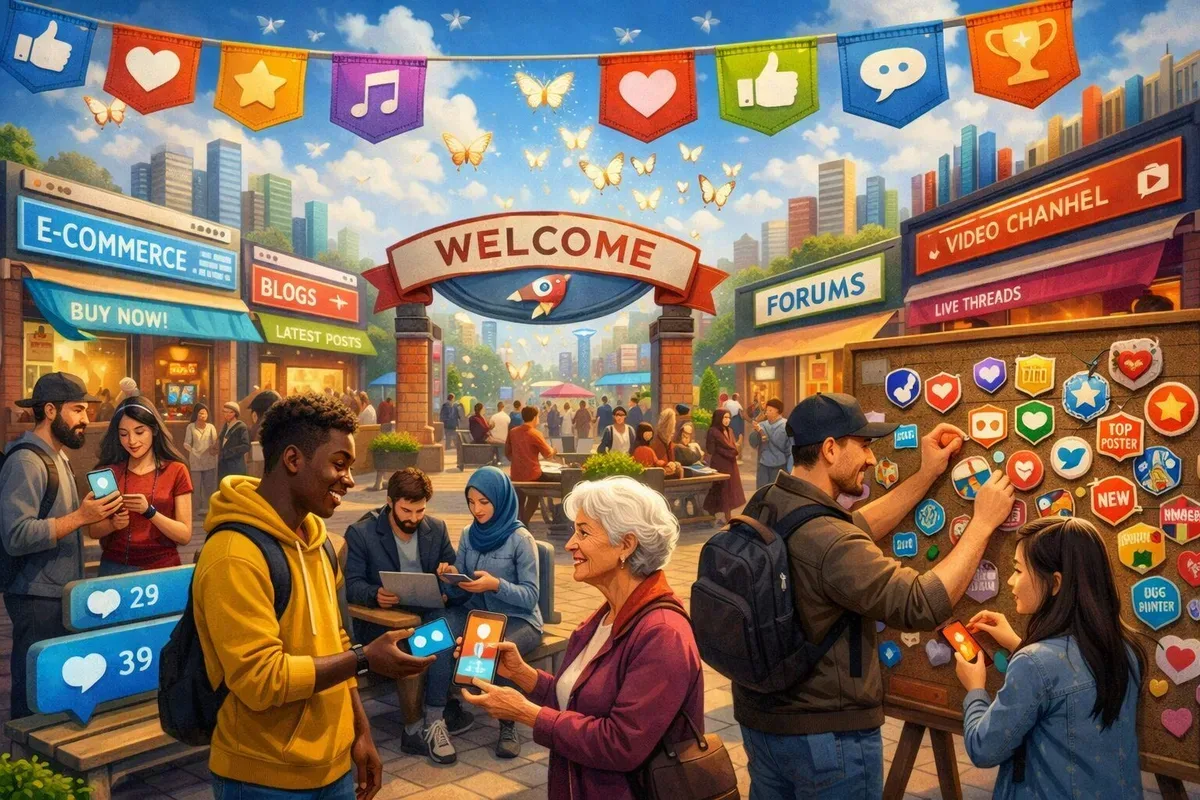
A different metric: customers as community members, not transactions
Most marketers count conversions as single events: a click, a form, a sale. What if each conversion were reframed as an invitation? When you get a new customer from website traffic, you’re not just adding a number to a dashboard — you’re onboarding a potential community member.
This shift changes priorities. Instead of maximising short-term conversion rates at any cost, you design experiences that introduce people to shared values, rituals and language. The signup page becomes an entry gate that explains what the group cares about, the first email is a welcome that sets tone, and the onboarding sequence is the first week of belonging. That perspective makes acquisition an exercise in community-building, not merely revenue generation.
Traffic as a neighbourhood — mapping journeys into local culture
Think of website traffic like footfall in a high street. Different sources are different streets and public spaces, each with its own culture. Organic search is the library — people seeking answers. Social is the café — folks primed for conversation. Paid ads are the market stall — quick transactions. Converting customers from each channel requires translating the local culture into a warm greeting.
This means tailoring micro-experiences: make search landing pages deeply helpful and trustworthy; craft social landing pages that invite comments, stories and sharing; design ad landing pages that funnel into a light-touch community ritual (welcome message, small freebie, invitation to a group). Over time these micro-rituals become shared cultural touchstones among your customers, knitting them together.
Rituals, symbols and simple ways newcomers become insiders
Communities thrive on repeatable rituals and recognisable symbols. For websites, these can be tiny: a branded onboarding checklist, a cheeky progress bar, an exclusive badge offered after first purchase. These elements transform a transaction into initiation. Someone who completes the checklist feels like an insider; someone who shows the badge in a forum earns recognition.
Designing these rituals intentionally increases the chance that a new customer sticks around and invites others. User-generated celebration moments — sharing a ‘first purchase’ social card or posting a before/after with a campaign hashtag — create social proof and strengthen the group identity. The conversion is no longer the end; it’s the start of a repeating social act.
Spaces that last: converting customers into recurring community contributors
Long-term community strength depends on giving customers places to contribute. Your website should be more than a storefront: think forums, comment threads, knowledge bases with contributions, or simple ‘customer stories’ submission forms. Each new customer brought from traffic can be nudged to contribute in small, low-friction ways — rate a product, leave a tip, answer a newcomer’s question.
Those contributions accumulate into shared resources, social proof and a sense of mutual ownership. Over time the community’s collective knowledge reduces friction for future customers and makes acquisition more sustainable. A mature community attracts traffic that converts at higher lifetime value because newcomers sense a living ecosystem, not a vendor.
Tools and automation that humanise, not hollow, the welcome
Automation often gets a bad rap for depersonalising relationships. But used thoughtfully it scales the kind of human touches that make a community feel alive. Welcome sequences that adapt to a user’s origin, AI-generated personalised content, and automatic invites to relevant subgroups can create the feeling of a bespoke welcome at scale.
Quick note: tools like autoarticle.net offer AI article generation for platforms such as WordPress and HubSpot. When combined with community-focused onboarding, automated content can keep conversations fresh, spark member contributions and ensure every new customer sees content that resonates with their reason for coming. The key is to use automation to deepen belonging, not replace it.
Measuring success differently: network effects, not only ROAS
Traditional KPIs — cost-per-acquisition, conversion rate, ROAS — still matter, but they’re incomplete. Add metrics that capture community health: number of returning contributors, average replies to first-time posts, content shares generated by newcomers, and member-to-member referrals. These reveal whether website traffic is feeding a living community or producing one-off buyers.
When acquisition teams report network growth alongside revenue, strategy changes. You invest more in spaces that amplify member voices, in rituals that encourage repeat interactions, and in content that sparks collective activity. That’s where website traffic turns into a self-reinforcing ecosystem.
A closing thought: designing for people who bring others
If your aim is to turn website visitors into customers, design every touchpoint with the next person in mind. Ask: will this experience make someone want to tell a friend? Will it provide something worth sharing? Community-minded acquisition flips the script — success isn’t just a sale, it’s creating advocates who expand the neighbourhood.
The next time you optimise a landing page or launch a campaign, imagine the newcomer two steps in: first they sign up, then they share. Build for that second step and you’ll find your customer acquisition becomes community creation.