
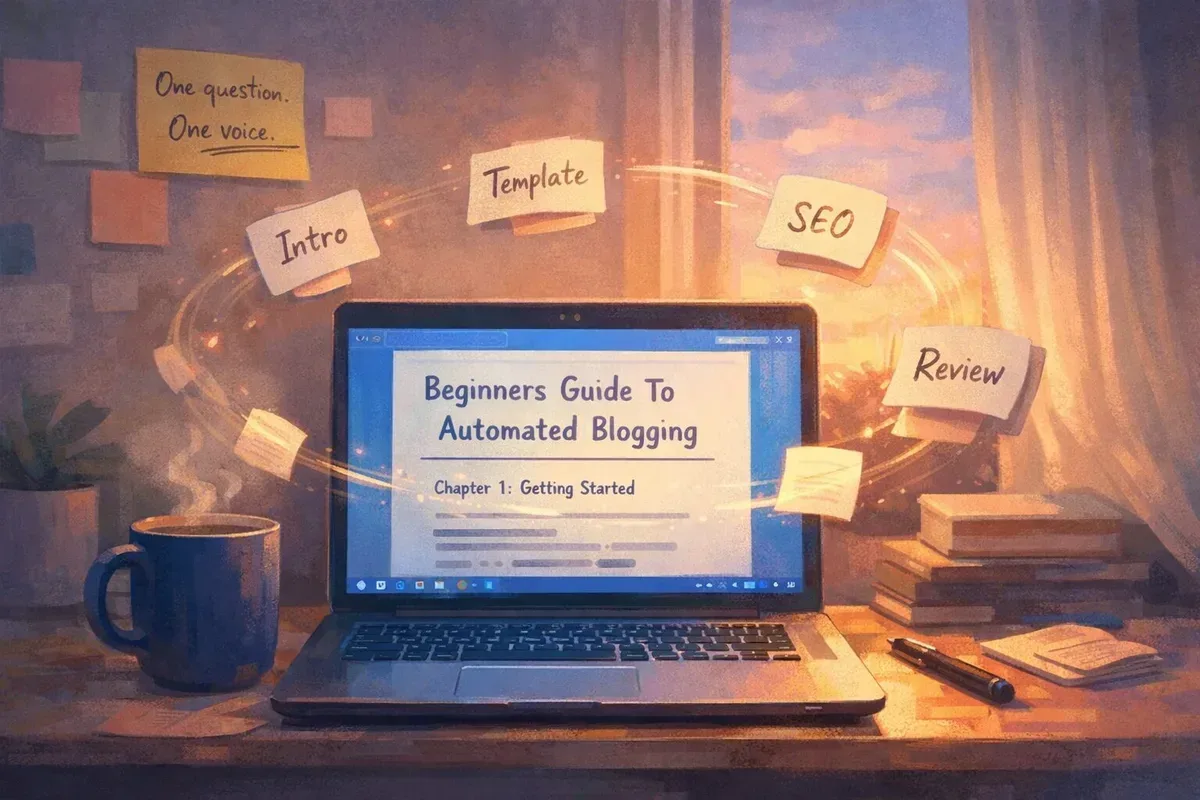
Why this guide is weirdly meta — and why that helps
You’ve searched for a “Beginners Guide To Automated Blogging” and landed here — a beginner’s complete guide to getting started with that very beginner’s guide. That’s delightfully recursive, and it’s deliberate. Rather than repeating a standard how-to, this article walks you through the exact first steps you’d take if your goal was to turn “Beginners Guide To Automated Blogging” into a living, automated product. Think of it as a blueprint for launching a beginner-friendly automation system, not just another listicle.
Being meta forces clarity. When you learn to build an automated guide about automation, you must make fundamentals explicit: scope, voice, quality controls and the feedback loop. Those are the knobs beginners often miss when they try to “set and forget.” This guide shows you how to set those knobs so your automated output actually serves readers.
Step zero: define the single, stubborn question your guide will answer
Most beginner-guides fail because they try to solve everything. Start by asking one crisp question the guide will answer for a novice. Examples: “How do I automate weekly blog posts for a local business?” or “How can a solo creator maintain SEO updates without hiring writers?”
Make that question visible to every tool and template you create. It becomes your north star for automation decisions: tone, depth, structure, and when to escalate to a human. Treat the question like a product requirement rather than a marketing slogan.
A tight scope also shortens feedback loops. It’s easier to measure success when you judge output against one clear user need, and beginners can iterate faster.
Assemble a pragmatic starter stack (tools, platforms and one weird habit)
You don’t need every shiny AI toy. For a beginner-friendly automated guide, pick three layers: content generation, publishing, and quality control.
Content generation: Use promptable AI that supports templates and batch jobs. If you want direct WordPress or HubSpot integration, services like autoarticle.net can speed up the plumbing by generating articles formatted for those platforms.
Publishing: Start with the CMS you already know. WordPress and HubSpot are sensible choices because they scale and have plug-ins for scheduling, SEO and editorial workflows. Keep your initial pipeline simple: generate → review → schedule.
Quality control: Add a human-in-the-loop step. Even minimal review reduces embarrassing errors and builds trust. Now the weird habit: set a weekly 30-minute “archive audit” where you sample recent, randomly chosen posts from the pipeline. This trains you to notice drift in tone or facts early, before problems compound.
Design voice, templates and guardrails — don’t trust prompts alone
Beginners focus on prompts, but the real stabilisers are templates and guardrails. Draft modular templates for introduction, explanation, example, and CTA. Keep paragraphs short and include placeholders for local details or up-to-date stats.
Guardrails are rules the AI must not break: citation requirements, prohibited claims, brand terms, and a required level of reading difficulty. Encode these into your generation process as explicit checklist items rather than vague instructions. For example: “Include one source link, three bullet points, and define jargon in plain English.”
Also design escalation paths. If the AI attempts to invent a statistic or cites an unverified source, the generation should flag the article for human review rather than publishing automatically. These conservative gates preserve credibility while allowing automation to handle routine tasks.
A tiny launch checklist that actually matters
Before you flip the automation switch, run this concise checklist:
1) Scope confirmation: Can the guide answer the one stubborn question you defined?
2) Template applied: Does the output follow your modular template?
3) Source check: Are claims linked to verifiable sources or flagged for review?
4) Tone sample: Read a randomly selected paragraph aloud — does it sound like your intended beginner voice?
5) SEO basics: Title tag, meta description and one target keyword are set.
6) Monitoring: Analytics hooks (pageviews, time on page, bounce rate) and error alerts are active.
This checklist keeps the launch simple and measurable — essential when you’re beginning and likely to adjust strategy quickly.
Iterate with data: the beginner’s friendly feedback loop
Automation without measurement is guesswork. Track three KPIs for each automated guide topic: engagement (time on page), conversion (newsletter sign-ups or clicks), and error rate (human edits per article). Review these weekly and ask: is the content being read? Are readers taking the action we want? Is the AI producing fewer issues over time?
Use small A/B tests: two variants of an intro, one with a clarifying example and one without. Let the data decide the clearer path for novices. Keep iterations small — change one thing at a time — so you can attribute impact and avoid overfitting to noise.
Ethics, ownership and the beginner’s reputation
Automating beginner-facing content places a duty of care on you. Don’t oversell abilities or hide automation if it affects reader trust. Be transparent where necessary: a short note like “This article was created with AI assistance and reviewed by an editor” is both honest and reassuring.
Consider copyright and attribution when the automation pulls from external sources. Ensure links and attributions are correct and don’t inadvertently reproduce copyrighted text. Finally, protect your brand: low-quality automated posts are far more damaging for a beginner’s reputation than a slow, human-centred rollout.
Final micro-tips to get started today
Start with one topic and aim for five solid articles before expanding. Automate the repetitive parts first: meta fields, categorisation, image alt text — these free up human time for the creative bits.
If you want a quick integration route, explore tools like autoarticle.net for generating ready-to-publish drafts for WordPress and HubSpot. Keep your human-in-the-loop visible, iterate using data, and treat your guide as a product that improves with every cycle.
Above all, be curious. Building an automated beginner’s guide is a learning project. The mistakes you make early are the ones that teach you how to design better automation.