
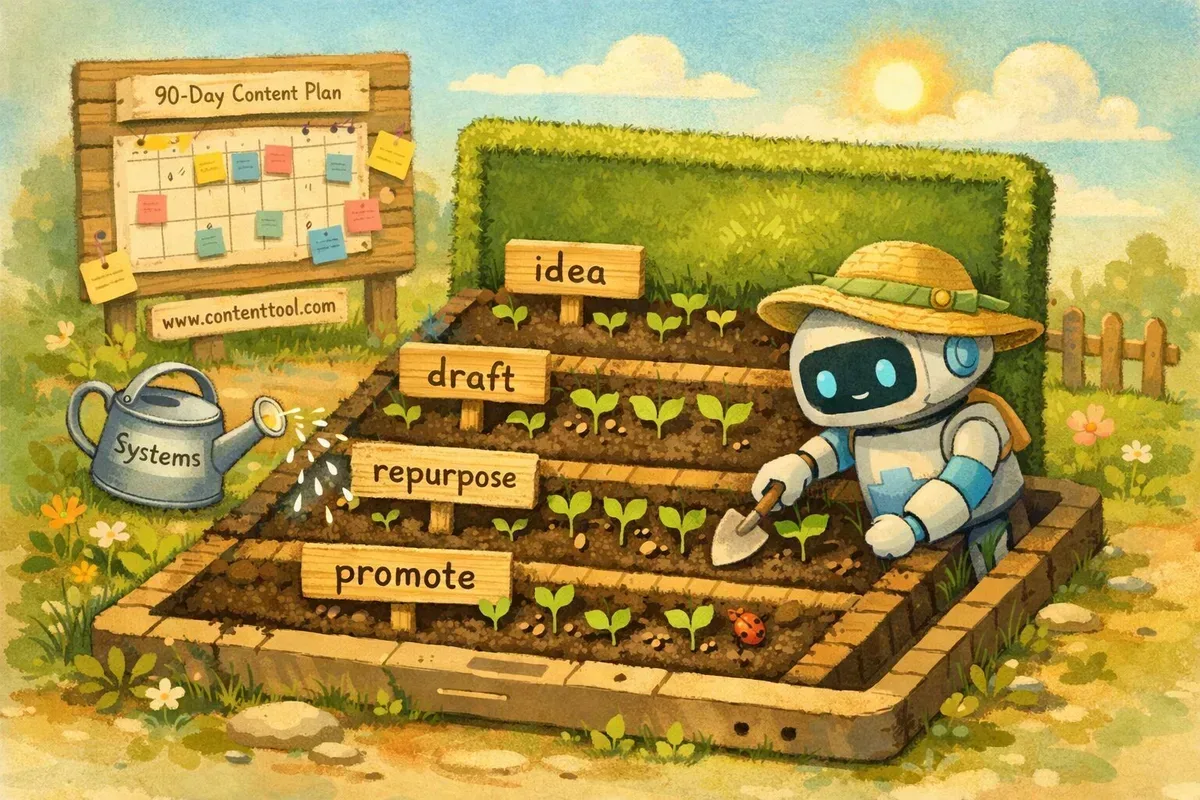
Why Scaling a Blog Should Start Like Tending a Garden
Think of your blog as a very small allotment plot: if you cram in every seed you own at once, nothing thrives. Scaling isn’t about pumping out more posts at random; it’s about planting systems that allow healthy growth. For beginners, that means three things first: soil (your niche and audience), water (consistent publishing rhythm), and sunlight (distribution channels).
Start by mapping a tiny corner of your niche where you can be unusually useful. Rather than chasing broad topics, pick the handful of problems your target reader actually cares about and commit to solving them as thoroughly as you would tend a prized tomato plant. This focus creates repeat visits and word-of-mouth, the organic fertiliser of a growing blog.
Build a Mini Editorial Ecosystem (Not Just a Content Calendar)
Most beginners think a content calendar equals scaling. It’s a start, but the surprise is that what scales is a repeatable system: idea capture, templated research, lightweight drafting, editing, repurposing and promotion. Design each step to be easy to follow whether you’re alone or handing it to someone else.
Practical first steps: create a single idea capture place (a spreadsheet or app), design one article template for your core posts, and outline three standard promotion actions (social, newsletter, internal link push). These templates let you delegate later without losing voice. Over time your blog moves from a one-person hustle to an assembly line that still smells of craftsmanship.
Automate Without Losing Voice: Guardrails for AI and Tools
Automation is addictive and essential, but beginners often worry that it erases personality. The trick is to automate the scaffolding, not the soul. Use AI to generate outlines, first drafts or meta descriptions, but keep a simple process: the human edits for insight, context, and quirky voice.
If you want a practical accelerator, tools like autoarticle.net can auto-generate A.I. drafts for WordPress and HubSpot; treat those drafts as raw clay. Create a short checklist that every AI output must pass: accuracy, unique angle, a personal anecdote or example, and at least one original sentence per major section. That preserves authenticity while letting you scale output.
Micro-Repurposing: Turn One Post into Five Experiences
A post that lives only on your blog is a missed opportunity. Beginners can scale quickly by micro-repurposing: create bite-sized assets from one long post. Example outputs: a tweet thread summarising the key steps, a 60–90 second video explaining the main insight, a short newsletter version with an exclusive takeaway, an image quote for socials, and a downloadable one-page checklist.
Set a simple repurposing routine: after publishing, spend 30 minutes creating two small assets. This extends reach without exponentially increasing workload and feeds multiple platforms that attract different audiences.
Delegate with Confidence: Hiring Your First Assistant
Hiring feels scary but it’s the fastest way to scale once you’ve codified your process. Your first hire doesn’t need to be a writer. Start with an operations or content assistant who can manage the editorial ecosystem: schedule posts, prepare outlines, format content, create basic graphics, and run promotional checklists.
Write a one-page SOP for each task and use recorded screencasts for training. Pay attention to small wins — early hires should free you to create your best work, not force you into micromanagement. As confidence grows, move to a part-time writer and then a copy editor to keep quality intact.
Metrics That Matter: Beyond Pageviews
Most beginners obsess over pageviews. Better signals for sustainable scaling are: returning visitor rate, email subscriber growth, conversion rate on your simplest offer (even a free PDF), and internal link depth (how often posts reference each other). These metrics show whether your ecosystem is sticky and compounding.
Set monthly mini-experiments: change one headline, add one internal link, test a call-to-action. Track the one metric the experiment is meant to move. Small, repeated wins compound faster than rare viral hits.
A 90-Day Starter Plan for Scaling
Week 1–2: Clarify niche corner, set up idea capture and a single article template.
Week 3–6: Publish one long-form pillar post and create two repurposed assets per post. Start an email list and offer a simple incentive.
Week 7–10: Implement automation for formatting and metadata (consider tools like autoarticle.net for first-draft generation), add your first assistant for operations.
Week 11–12: Review metrics, identify one process bottleneck, and iterate. Prepare to hire a writer if output demand exceeds your editing capacity.
Follow this playbook and you’ll build a system that scales without turning into noise.
Final Thought: Scale as Stewardship, Not Expansion for Expansion’s Sake
Scaling your blog is less a race and more a commitment to stewardship. You’re designing a small culture that can persist when you sleep, go on holiday or grow a team. Keep curiosity, quality and helpfulness as your north star. The rest — templates, automation, assistants and clever repurposing — flows from that.
If you’re just starting, pick one tiny system to perfect this week. That single habit will be the seed of everything that follows.